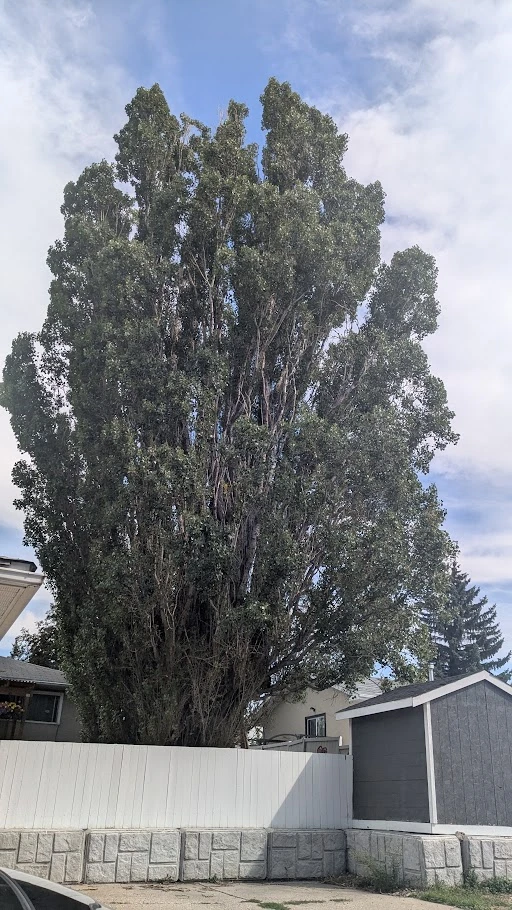
Londonderry Lombardy Poplar
Lombardy Poplar (Populus nigra f. italica)
Lombardy Poplar
About this verified tree
This Lombardy poplar is likely a product of the Indian Head tree nursery, later the Prairie Farm Rehabilitation Administration (PFRA) Shelterbelt Centre, which from 1901 to its closure supplied hundreds of millions of seedlings across the Prairies. While PFRA distributed a range of hardy shelterbelt species, Lombardy poplar was especially valued in the mid-20th century for its extremely fast growth, narrow columnar form, and ability to create an instant living wall for wind protection. Its vertical habit meant it could be planted in single-row shelterbelts along farmyards, roads, and property lines without shading too much cropland. The post-war decades (1950s–60s) were a peak period for both PFRA output and Prairie farmstead modernization, making this the most likely era of planting. Although disease susceptibility shortened the lifespan of many Lombardy rows, surviving specimens like this one represent a rare legacy of the Prairie shelterbelt movement and the mid-century push to quickly establish protective tree cover in a harsh climate.
- Species
- Lombardy Poplar
- Scientific name
- Populus nigra f. italica
- Area
- Alberta
Heritage Categories
Significance
This Lombardy poplar is likely a product of the Indian Head tree nursery, later the Prairie Farm Rehabilitation Administration (PFRA) Shelterbelt Centre, which from 1901 to its closure supplied hundreds of millions of seedlings across the Prairies. While PFRA distributed a range of hardy shelterbelt species, Lombardy poplar was especially valued in the mid-20th century for its extremely fast growth, narrow columnar form, and ability to create an instant living wall for wind protection. Its vertical habit meant it could be planted in single-row shelterbelts along farmyards, roads, and property lines without shading too much cropland. The post-war decades (1950s–60s) were a peak period for both PFRA output and Prairie farmstead modernization, making this the most likely era of planting. Although disease susceptibility shortened the lifespan of many Lombardy rows, surviving specimens like this one represent a rare legacy of the Prairie shelterbelt movement and the mid-century push to quickly establish protective tree cover in a harsh climate.
Species & Identity
How This Tree Compares
Species comparison is not available yet.
Species Leaders
History & Heritage
Measurements
Exceptional Measurements
This tree has measurements that exceed standard thresholds — it may be a record-breaking specimen.
Collections
Location
map Open Mapsheight Height Details
height = tan(angle) × distance + eye_height
beach_access Canopy Details
straighten Circumference Details
Record Metadata
Community Photos
Submit photos for community approval
Your Notes
Admin Controls
Record ID: —
Drag, select, or paste photos. They will be compressed to WebP before upload.