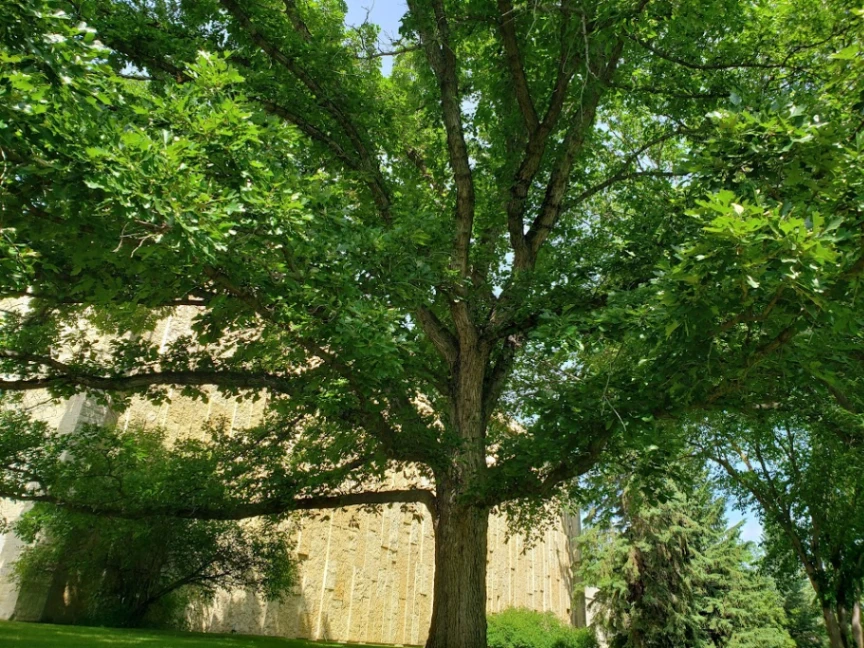
The Stark Oak
Bur Oak (Quercus macrocarpa)
Bur Oak
About this verified tree
The Stark Oak is a mature bur oak and one of the largest oak trees in Edmonton, and possibly the largest bur oak in Alberta. It currently grows on the grounds of the Royal Alberta Museum in Edmonton, where it has become a defining landscape feature. Bur oak is not native to Alberta and occurs here only as planted specimens, making this tree especially rare within the province. The tree’s history is closely tied to the Stark family. In 1965, John Stark offered to sell the oak from his yard to help cover medical expenses for his daughter Susan, who required specialized eye treatment, including consultations at the Mayo Clinic. The oak was already considered large at the time, with a wide canopy and strong structure, and was the sole survivor of roughly 100 trees planted in the area. In October 1967, the tree was purchased by Alberta Public Works and transplanted to the museum grounds the following month—a notable achievement given the species’ deep taproot and poor transplant tolerance. The tree survived the move, established successfully, and has since grown into a healthy, majestic specimen, with the original tree-spade ring still visible at its base.
- Species
- Bur Oak
- Scientific name
- Quercus macrocarpa
- Area
- Alberta
- Circumference
- 5.82 m
- Height
- 26.33 m
Heritage Categories
Significance
The Stark Oak is a mature bur oak and one of the largest oak trees in Edmonton, and possibly the largest bur oak in Alberta. It currently grows on the grounds of the Royal Alberta Museum in Edmonton, where it has become a defining landscape feature. Bur oak is not native to Alberta and occurs here only as planted specimens, making this tree especially rare within the province. The tree’s history is closely tied to the Stark family. In 1965, John Stark offered to sell the oak from his yard to help cover medical expenses for his daughter Susan, who required specialized eye treatment, including consultations at the Mayo Clinic. The oak was already considered large at the time, with a wide canopy and strong structure, and was the sole survivor of roughly 100 trees planted in the area. In October 1967, the tree was purchased by Alberta Public Works and transplanted to the museum grounds the following month—a notable achievement given the species’ deep taproot and poor transplant tolerance. The tree survived the move, established successfully, and has since grown into a healthy, majestic specimen, with the original tree-spade ring still visible at its base.
Species & Identity
How This Tree Compares
Species comparison is not available yet.
Species Leaders
History & Heritage
Measurements
Exceptional Measurements
This tree has measurements that exceed standard thresholds — it may be a record-breaking specimen.
Collections
Location
map Open Mapsheight Height Details
height = tan(angle) × distance + eye_height
beach_access Canopy Details
straighten Circumference Details
Record Metadata
Community Photos
Submit photos for community approval
Your Notes
Admin Controls
Record ID: —
Drag, select, or paste photos. They will be compressed to WebP before upload.